
Guard and Dodge Mechanics
Home > Gameplay Preview > Guard and Dodge Mechanics
Defense Tuning for Fast-Paced Combat
Q:
Can Phantom Blade's defensive mechanics keep pace with its rapid combat tempo?
A:
Phantom Blade features a fascinating defensive model that feels like an adaptive baseline system, seemingly built to complement its blistering combat tempo.
Base Adaptive Defense
Mechanics Overview
In short, pressing Guard during a basic attack, Sha-Qi attack, dodge, or while reeling from a hit cancels the current animation into an instant block that negates damage.
Alternatively, you can tap guard just before initiating an assault. This queues an active defensive buffer beneath your inputs, allowing attacks to proceed unimpeded while instantly triggering damage negation the exact frame an enemy hit connects.
Combat Query: When canceling an attack into a guard, does it activate instantly upon pressing the guard button, or only after an incoming blockable hit is registered? This distinction determines whether the underlying adaptive defense must be primed before launching an attack or if it can be triggered reactively mid-animation.
Usage Scenario
Mastering these core defensive mechanics equips players with reliable fail-safes and recovery options throughout both offensive and defensive combat.
When confronting formidable adversaries, mastering these recovery scenarios is essential:
If an enemy's quick flurry lands its opening blow, immediately raise your guard to deflect the following strikes. Failing to mitigate the incoming hits can easily cost you a devastating chunk of vitality.
② Swap weapons promptly after a guard break to restore your defensive capabilities.
Important Notes
Naturally, this mechanic cannot shield Soul indefinitely. On top of being defenseless during posture recovery and helpless against unblockable red-glint attacks, there are several key caveats to keep in mind.
Soul appears to have certain high-commitment techniques that cannot be canceled via parries or dodges, leaving him exposed throughout the animation. During the State of Play Lion Dance showdown, the concluding Wind & Thunder dual-blade art lacked invincibility frames and failed to stagger the boss. To prevent accidental cancels on costly maneuvers, such signature arts likely cannot be aborted mid-cast—so pick your openings wisely and avoid trading hits.
Sha-Qi demands careful resource management. Sustained guarding depletes Sha-Qi, so maintaining a safe defensive cushion means moderating your offensive spending. Although Sha-Qi attacks can be interrupted, their resource cost is deducted upfront and never refunded upon cancellation. If you are unsure how long an opening will last, commit to Sha-Qi attacks right away or refrain from using them entirely.
Outcome of Guarding & Dodging by Attack Type
How do standard strikes, red/blue glints, and black-aura moves interact with your defensive and evasive options?
Evasion
Dodging different attacks yields largely the same outcomes, so we'll cover them all together.
- Players likely cannot maintain unbroken invulnerability frames simply by mashing dodge. While earlier builds had clear vulnerability windows between chained step-dodges or Jade Twin Rings teleports, the newly introduced double and triple flips are almost certainly designed with gaps as well.
- Timed properly, a clean dodge will negate virtually any incoming attack.
- Dodging consumes no Sha-Qi and leaves enemy Sha-Qi untouched, whether successful or not.
Dodging an enemy's red-flash strike often triggers a Ghost Step counter and recovers Sha-Qi.
Curious edge cases remain where an incoming strike is avoided without triggering Ghost Step, though whether this stems from dodging cleanly out of range or another mechanic is still unconfirmed.
Defensive (Guard & Perfect Guard)
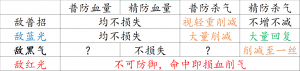
Results of Normal Guard vs. Perfect Deflect Across Enemy Attack Types
As shown in the table above
Enemy basic attacks deal zero damage through any block. Normal blocking depletes Sha-Qi based on attack weight, while a Perfect Parry keeps your Sha-Qi entirely untouched.
Enemy Blue Flash: Nullifies all health damage when blocked. Standard guards severely deplete your Sha-Qi, but a Perfect Guard restores a large amount of Sha-Qi and unleashes a Ghost Step counter.
Enemy Black Aura: A mechanic still under analysis. Available footage indicates that a Perfect Guard prevents all health damage, though Sha-Qi is instantly dropped to a sliver—safeguarding against a posture break regardless of your initial gauge.
Enemy Red Flash: Unblockable. Direct hits deplete both Health and Sha-Qi.
Enhanced Guard or Dodge
Certain weapons enhance defense or evasion, such as
- Grants sustained defensive capability (slice through marionette threads using a soft sword)
- Increases guard and dodge leniency (Jade Twin Rings dodge; Twin Hooks appear to be a parry stance)
- Increases Perfect Guard bonuses (Savage Blade of Subjugation, Broken Sword of the Infatuated)
Telegraph Elements
Q:
How do you counter the off-screen attacks accompanied by aura pillars around Soul during the Lifechaser and Wild Wanderer fights?
A:
The aura pillar eventually reveals distinct visual cues—your sole indicator for timing parries and counters.
When executed properly, these cues act like a starter pistol: the moment it cracks, you must react instantly—neither jumping the gun nor lagging behind.
Telegraph Placement Windows
Visual cues must surface at least 0.25 seconds prior to damage calculation. A human player's cycle of perception, decision-making, and execution averages around 0.25 seconds in action games; any indicator appearing later than that leaves virtually no room for reaction.
The window between the earliest tell and the damage frame equals the baseline reaction time plus counter invulnerability frames (e.g., 0.25 + 0.3 seconds). If the prompt triggers prematurely, a player who reacts will see their invulnerability expire before the hitbox lands, leaving them exposed during their recovery animation.
Available Telegraph Types
Telegraph design is a cornerstone of responsive counter-combat; if handled poorly, players will inevitably abandon the game's parry-and-strike systems. Setting deeper theory aside, let us look at the primary categories of telegraph cues available.
Reaction cues can manifest in diverse ways: the telltale start of a strike ('kinetic' cues), a sudden deceleration or pause as power gathers ('static' cues), a flash of light, an audio cue, particle shifts, or readable projectile and charge trajectories. Ultimately, any stimulus that is distinct, tightly timed, and intuitively understood by the player can serve as an effective reaction cue.
("Stillness"-type parameters are frequently overlooked and misunderstood)
An enemy's combat style usually dictates their reaction profile. While visual cues and weaponry offer hints beforehand, direct confrontation is often required to truly understand their behavior.
Special Cases of Brisk Combos
Brisk combo chains are uniquely tricky, making it impractical to assign distinct reaction prompts to every hit. In such cases, indicators are typically tethered only to pivotal strikes within the flurry, such as the opening and closing blows.