


The Legend of Khiimori immerses players in a world where mastering horses isn’t just a sideline but a crucial element of survival and efficiency. Early in the game, understanding the nuances of purchasing, breeding, skill training, and traits sets the foundation for creating a stable of powerful and dependable horses that enhance every expedition.
Horses Guide
Grasping how horses operate in The Legend of Khiimori is essential for players aiming to gain an edge in exploration and resource delivery. Horses are more than mounts—they are companions whose stats and training directly impact your gameplay.
Buying Your First Horse
Jumping straight into breeding might seem tempting at first, but patience is vital here. The game nudges players to proceed through initial quests and complete the tutorial before stepping into horse ownership.
Once you complete the tutorial sequences, an NPC named Yisu rewards you with funds earmarked for purchasing your first horse. This introduction is designed to ease players into managing their equine assets without overwhelming choices.
At this starting gate, the selection is limited to three basic coat patterns—functional but not flashy. These options serve as placeholders to get your stable started before a more diverse range opens up.
The vendor offers three types of horses at this stage:
- A strong horse
- A fast horse
- A balanced horse
Your choice should reflect your preferred playstyle. For those focusing on carrying capacity and brute endurance, the strong breed offers distinct advantages. Personally, the strong horse fit my early needs better than speed or balance.
You can also pick among several breeds:
- Mongolian horse
- Akhal Teke
- Ferghana
I opted for the Ferghana, noted for its high strength, ideal for carrying heavier loads during early deliveries.
Understanding core stats clarifies their gameplay impact:
- Strength increases your horse’s carrying capacity.
- Endurance improves stamina efficiency, letting your horse travel longer.
- Balance reduces the risk of stumbling on difficult terrain.
This choice is flexible; you aren’t locked in permanently with your first horse. The option to sell it later to the horse trader lets you upgrade as you unlock better mounts. Initially, it’s about having a dependable companion to progress further.
The Breeding Process
Breeding horses becomes a viable option once you gain more experience and resources. It’s a mechanic that rewards investment and careful planning, enabling you to craft horses with tailored traits and stats.
Breeding requires at least three horses in your stable:
- One horse designated for riding
- One stallion (male horse)
- One mare (female horse)
You need both a stallion and a mare to successfully breed new foals. Without one or the other, breeding is impossible.
Visit the horse trader to acquire breeding stock. Save 1000 coins beforehand to access a good selection and consider waiting for the trader’s inventory to refresh if the current options don’t fit your breeding plan.
Each breeding session costs 20 coins. After initiating breeding, the foal appears the next in-game day. To avoid downtime, you can speed things up by sleeping in the nearby shack until sunrise.

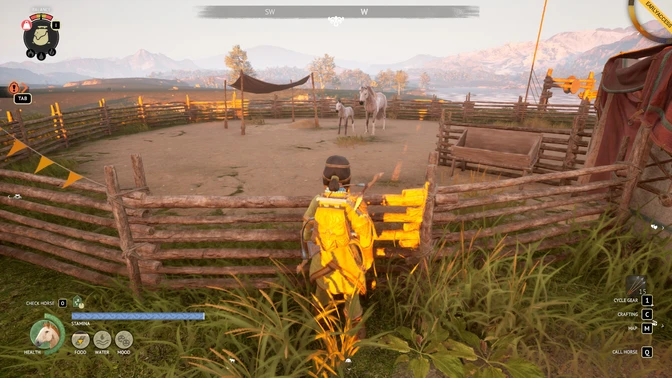
To interact with the mare and the newborn foal, approach the gate on the left side of the breeding station; this teleports you inside the pen where you can pet and bond with your horses.
It typically takes around three in-game days for the foal to mature and become rideable, allowing you to expand your delivery team with fresh steeds.
Horse Skills and Stats
Horses in The Legend of Khiimori develop through five core, trainable skills that influence their performance in various scenarios:
- Strength
- Agility
- Endurance
- Balance
- Spirit
Press O to open your horse’s profile, which offers a detailed explanation of these stats and how they affect your horse’s abilities in the field.

Each skill improves through specific activities during your rides, letting you customize your horse’s growth based on your priorities.
Strength Training
- Carrying heavy cargo
- Traversing tough terrain like sand, snow, mud, and water
- Enduring injuries or poison exposure
Interestingly, a horse that trips and suffers injury can see an increase in strength, but care is required to avoid long-term negative effects caused by unattended injuries.
Agility Training
- Galloping at high speed
- Riding on challenging surfaces such as rock, ice, and forest
- Executing power stops
Forests provide a prime environment for agility training if you maintain higher speeds, helping your horse sharpen reflexes and handling.
Endurance Training
- Riding while the horse has low health
- Withstanding freezing temperatures
- Withstanding hot weather conditions
Balance Training
- Riding uphill
- Maintaining control when unbalanced
- Riding into strong headwinds
You can simulate unbalanced riding by unevenly loading cargo on your horse, which challenges its stability and improves balance over time.
Spirit Training
- Jumping over obstacles
- Facing frightening situations such as fleeing predators like bears and wolves
- Riding with low stamina
Riding your horse while it has low stamina can hurt its spirit slightly, so this method requires caution.
Horse Traits
Horses exhibit unique personality traits that influence their mood and effectiveness. These traits can either bolster or hinder performance under certain conditions.
One Mongolian horse I have, named Bchan, displays these traits:
- Nocturnal: mood improves at night
- Drinker: higher water consumption
- Lazy: mood drops when galloping
Another mare, Athena, has contrasting traits:
- Galloper: mood boosts while galloping
- Wind Spooked: mood decreases after prolonged wind exposure
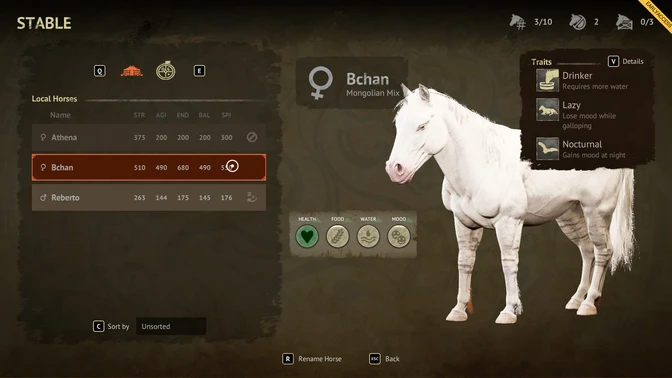

These traits are inheritable through breeding, adding a strategic element to developing your ideal horse lineage over time.
Wild Horses
Currently, in this early access phase of The Legend of Khiimori, interaction with wild horses is not available.

Although taming or breeding wild horses isn’t possible yet, they add to the immersive atmosphere and may become relevant in future updates.